
Sitting with Uncertainty
From quantum physics to wind farms and AI, this year’s collection shows Australian science writing at its most curious, and its most conflicted.

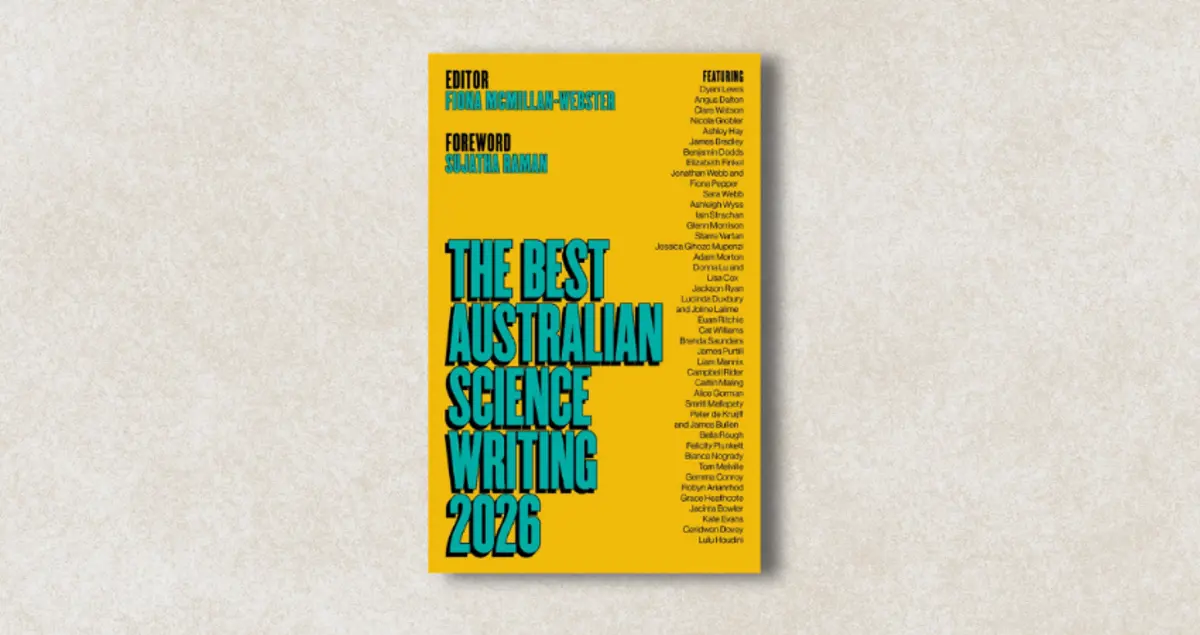
Review: The Best Australian Science Writing 2026, Fiona McMillan-Webster (ed.), Newsouth
The pieces appearing in this latest round-up of Australian science writing are diverse, but we can also see trends and preoccupations. Questions of origins and the make-up of the universe continue to fascinate, indicative of our quest for knowledge, but there is also an emphasis on how science is applied to the various issues that cause problems for contemporary society, environmental issues being front and centre.
Quantum physics features, continuing to intrigue and perplex. In an article on neutrinos, the authors comment on the relentless pursuit of knowledge, the deep desire to understand the unseen, a perspective science shares with religion, even if they are often placed in contrast. Jessica Gihozo Mupenzi, a young ‘emerging writer’ of talent, links quantum physics and the immigrant experience. Riffing on Heisenberg’s uncertainty principle, she offers a different perspective on science, arguing that it might be good to sometimes sit with the uncertainty of not knowing.
In the foreword of the book Sujatha Raman emphasises the creativity of science. Ashley Hay describes how an ecologist applies her skills to soccer, where she analyses not speed or fitness but dexterity in a pioneering talent identification system. Sometimes science opens up a whole new field of questions, as with exoplanets, a recent prompt to the imagination of astronomers and public alike. (The first exoplanet was only definitively identified in the 1990s.)
Related to this is the pursuit of signs of alien life on distant planets via the James Webb Telescope. Here we see the spirits of historians of science Karl Popper and Thomas Kuhn, who emphasised, respectively, falsification and innovation as being key components of science. Innovative scientists look for atmospheric chemical signatures as evidence of alien life, while their contemporaries pour cold water on claims of ET life by envisaging other, more mundane explanations.
Environmental issues are unsurprisingly prominent in many of the pieces in this collection. Clare Watson reports on Wollongong, previously a centre of fossil fuel industry and now exploring making steel without coal. One expert she encounters argues that we have the technology and it is only attitudes and planning that hold us back. The piece has an optimistic tone but also perhaps indicates the size of the mountain we have to climb to replace fossil fuels with green energy. Jobs remain, of course, critical in these discussions. Other pieces on fire and water explore the problems of European-style living on a hot, dry continent.
A number of articles touch on the issue of threatened species, and the associated complexities, such as in the release of bandicoots on French Island in Victoria, where local reactions have been mixed. In the case of wind farms and endangered parrots in Tasmania we see not only how science addresses environmental problems, but also the complications of competing priorities. Similarly, with AI, one article here reports on how it is helping with targeted cancer treatments; on the other hand, it widely fails as a therapist.
Good science writing moves beyond the technical to inspire or intrigue, is evocative of place, urgent in moralising perhaps and articulate in distilling complex information. The book’s editor mentions Rachel Carson, and how Carson was surprised that others were surprised at her mixing of science and poetics. James Bradley gets a little philosophical with his expansive essay on time in nature and its disruption in modernity. Good science also needs to be embedded in a healthy culture, and Sujatha Raman rightly argues for the partnership of Western science and traditional Indigenous knowledge, itself a form of science. It is good to see an increasing emphasis on holism amongst the inevitable specialisation of science.
Elizabeth Finkel, in her piece about the history of science and its differing approaches, epitomised by Popper’s emphasis on falsification and Kuhn’s emphasis on innovation, offers a good reason why we need to promote the importance of good science – a reason that can be summed up in two words: Trump administration.
Comments
Moderated before publishingNo comments yet. Be the first to add to the conversation.
Leave a comment