
Youth Survey 2026 reveals what young Australians want fixed
After 25 years of listening to young people, Mission Australia’s latest Youth Survey shows how their worries about the nation and their own lives have changed.


Cost of living, housing and homelessness, and mental health are the three issues young people in Australia most want the nation to address, according to Mission Australia's Youth Survey 2026. Now in its 25th year, the survey gathered responses from 19,384 young people aged 14 to 19, with results released on 19 November.
Cost of living was named by 67 per cent of respondents, housing and homelessness by 28 per cent and mental health by 26 per cent. One young woman from Victoria put it this way:
"The cost of living as a whole needs to go down so people have the simple right and comfort of having a roof over their head, without fear of needing to skip meals in order to meet demands of rent and bills." Female, 18, Victoria
How concerns have changed
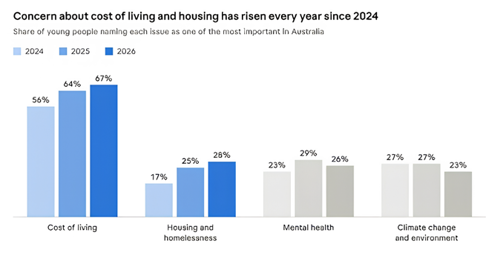
Source: Mission Australia Youth Survey Report 2026, Table 2.1 (national results, 2024 to 2026)
Cost of living has been the leading national issue for three consecutive years and has almost tripled as a concern since 2022, when it was named by 23 per cent. Housing and homelessness has more than doubled since 2022 (12 per cent) and, for the first time, is the second biggest issue in young people's eyes, overtaking mental health and climate change and the environment.
Housing and money pressures at home
Around one in 12 respondents (8.5 per cent) experienced homelessness or housing instability in the past year. Fewer than half (49 per cent) were confident they would be able to afford a safe place to live in the future.
Family conflict (39 per cent), cost of living pressures (30 per cent) and family violence (26 per cent) were the most common contributors to homelessness. For housing instability, the most common contributors were cost of living pressures (68 per cent), housing affordability (40 per cent) and family conflict (32 per cent).
One in six (16 per cent) experienced financial hardship in the past year, most commonly missing meals or having to seek financial help. One in five (20 per cent) agreed their family is often stressed about money.
"[One thing that could be changed in my neighbourhood to make my life better is] affordable houses. So we know that in the future we will have somewhere to live." Female, 16, Victoria
"If the housing crisis could be solved it would be lovely. Homeless people don't deserve to live on the streets. No one does." Male, 17, QLD
Stress closer to home
While affordability led views on national issues, the most common sources of personal stress related to study, time and wellbeing. More than half (55 per cent) were stressed by school or study problems, rising to 66 per cent of females compared with 44 per cent of males. Half (50 per cent) were stressed about managing their time, and 38 per cent about their mental health and wellbeing.
Seventeen per cent missed time at school due to anxiety, depression or mental health issues. Nineteen per cent reported high psychological distress, unchanged from 2025 and down from 22 per cent in 2024. Non-binary and gender diverse respondents reported higher stress across most measures, with half (51 per cent) in the high distress range.
"There are not enough services that work with young people and/or mental health. I feel like we need more activities or services that allow young people to feel more included in everyday decisions, and initiatives that push to eliminate stigma surrounding mental health. Especially to educate adults on how important mental health issues are in teenagers, and how to properly support them." Female, 17, Victoria
Support, confidence and ideas for change
More than half (56 per cent) felt positive about the future, similar to 2025 (58 per cent) and up from 47 per cent in 2024. Seventy-one per cent were confident they could deal with things that happen in their life, and 81 per cent rated their family relationships positively. Friends (79 per cent) and parents or guardians (76 per cent) were the sources of support most often rated helpful.
For the first time, the survey asked young people what one change in their neighbourhood would make their life better. A quarter (25 per cent) identified better access to infrastructure, services and transport, followed by stronger community connection (16 per cent) and improved safety and reduced crime (14 per cent).
What Mission Australia is calling for
Mission Australia CEO Sharon Callister said, "For 25 years, young people have trusted us to listen to what matters most to them."
"Young people shouldn't have to carry the weight of wondering where they are going to sleep or if their families can afford basic life essentials," she said.
"These findings show more action is needed to help young people build secure lives and futures, including greater investment in social and affordable housing, dedicated youth housing and adequate income support for those facing hardship."
The report also names Youth Foyers as an example of dedicated youth housing, and calls for evidence-based approaches that help young people early to prevent and end youth homelessness. A special report reflecting on 25 years of the Youth Survey will be released in 2027.
What this means for churches
The survey includes data relevant to faith communities. One in five respondents (20 per cent) took part in church or other faith groups outside school hours in the past year. The same proportion (20 per cent) rated a spiritual or religious mentor as a helpful source of support, while 68 per cent said they do not use one.
Several findings point to areas where congregations are already present in local communities. The neighbourhood changes young people asked for most often, such as stronger community connection, safe places to spend time and more activities for their age group, are things many churches can offer through their buildings, groups and volunteers. Young people also described wanting adults who understand mental health and wanting to be included in decisions.
For Uniting Church congregations, the findings offer a starting point for conversations about how young people in their area are faring, what spaces and connections are available to them, and how their views are heard in the life of the church.
Have your say in 2027
Young people aged 14 to 19, and schools, youth groups and organisations that want to take part, can register interest in Youth Survey 2027 here.
The full Youth Survey 2026 report is available at here.
Comments
Moderated before publishingNo comments yet. Be the first to add to the conversation.
Leave a comment