
Two Ways of Seeing Central Australia
Two new books look at Central Australia from opposite directions: the rediscovered Birrundudu Drawings, made by Aboriginal men in 1945, and Hans Heysen’s Flinders Ranges sketches.

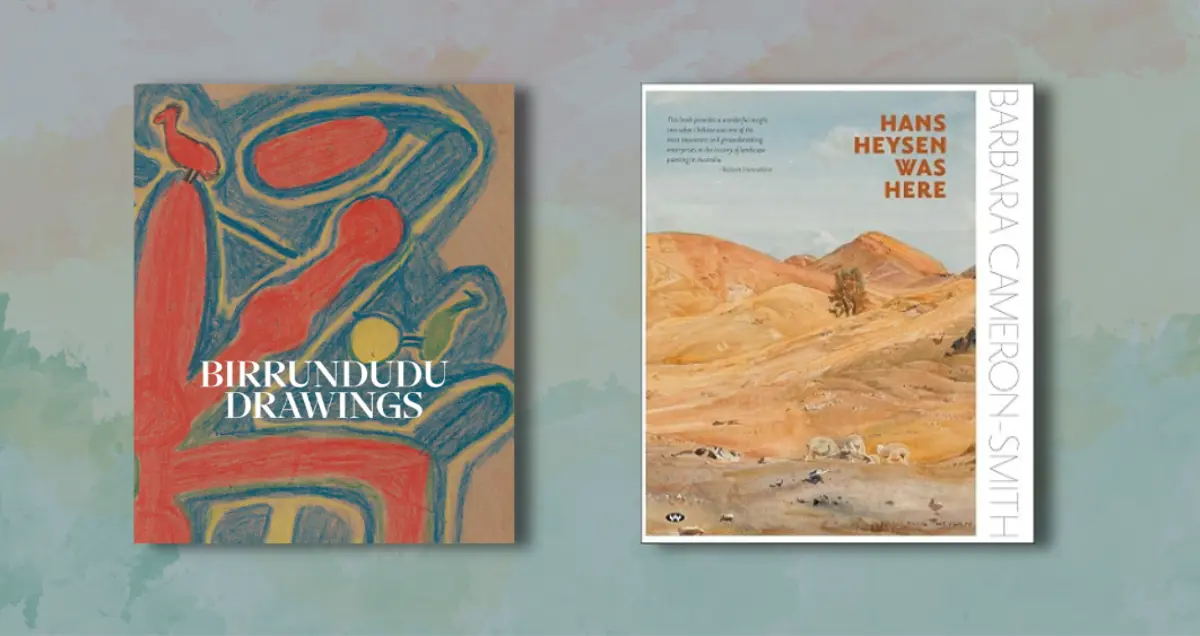
Review :Birrundudu Drawings, John Carty et al, Upswell Publishing and Hans Heysen was Here, Barbara Cameron-Smith, Wakefield Press
In 1945 pioneering anthropologists Ronald and Catherine Berndt travelled to the cattle station of Birrundudu, which straddled the NT/WA border, to document both elements of Aboriginal culture and the appalling conditions that the Aboriginal people there were subjected to as employees and dependants of the station.
When the couple ran out of camera film and supplies didn’t arrive, Ronald began drawing on brown packing paper with crayons, a process the community’s Aboriginal men quickly suggested they take over. Eventually, over 800 drawings were made. Elders directed younger men, new motifs were introduced and proliferated, and they debated which aspects of culture should be recorded. The drawings were accompanied by detailed field notes by the anthropologists.
The documentation ended when a government official visited and, because of the scarcity of food and water at the station, helped the Berndts leave. The Berndts had hoped to ‘influence policy and produce better material outcomes’ for the Aboriginal people used as cheap labour on stations, but this didn’t eventuate. The drawings were subsequently hidden in the anthropologists’ archive, forgotten for decades.
Rediscovered recently, the drawings were shared with descendants and community members, who were shocked to learn of their existence, in a long process over 2020-2024, also involving universities and museums. Although not ‘official’ recordings, they are an extraordinary, significant trove of culture references, some so sensitive that only male elders can view them, documenting aspects of Country and ceremony and also incidents such as the sexual exploitation of Aboriginal women by white pastoral workers, which was a constant source of agitation.
The beautiful and significant Birrundudu Drawings book reproduces many drawings deemed suitable for general viewing, with a square format, satisfying heft and matte pages and cover hinting at the feel of the brown paper. As well as recording the biographies of the men creating the works and the history of the station in the context of frontier exploitation of Aboriginal people, the book explores the process and feelings of Aboriginal people viewing the drawings today, and how they went about establishing connections, placing the artists and images into the histories they already knew, countering stories told from a white (colonial) perspective. According to the authors of the book, the drawings are crammed with so much cultural information that many years will be needed to unpack them.
The drawings are different to more recent Indigenous art works, such as those from Papunya, as they were not intended as artworks for sale, but the richness of their coverage is fascinating. The availability of materials dictated style: the crudeness of the crayons encouraged simplicity, although there were also serendipitous changes: when black crayons ran out, the men used pencils, allowing more detail. When certain colours wore out, the alternatives created striking contrasts. Although the authors of the book caution that we shouldn’t think of the documentation at Birrundudu as a ‘forerunner’ of the later, highly popular Western Desert art, art historians see them as prompting a ‘revision’ of the origins of that art.
Hans Heysen was Here also gives a different perspective on the art of Central Australia, but this time with less of an Indigenous lens. Hans Heysen is famous as a painter of gums; here the focus is on his journeys to the Finders Ranges and on quicker studies, done in pencils and watercolours, though still as exquisite as his oil paintings. This perspective returns a freshness to an artist who may be overly familiar to Australian audiences. I find the watercolours so lively and engaging as to be preferable over the more accomplished oils.
Heysen made numerous expeditions to the Flinders Ranges over two decades (roughly the 1930s and 40s), often with his son David, at first staying in hotels and stations; later they used a primitive pop-up camping trailer, which allowed them more flexibility in choosing camping and painting spots.
The book makes liberal use of the letters the Heysens sent back home to the Adelaide Hills, as much travelogue as art monograph. We learn a lot about his family and travels through heat and flood (though there are some inadvertent duplications of text across chapters, which is a little distracting). Hans and David delight in news from home and deliveries of home-made cake and bread.
We also learn about Heysen’s painting techniques, his looking for the right vistas, times and light. Early morning and late afternoon were favourites – as many painters know, the light is softer at those times of day, but, as Heysen mentions, the longer shadows make for better contrasts and interest. Many of the letters relay Heysen’s impatience with the changing conditions and being unable to capture a scene to his satisfaction. Such are the perils of painting en plein air.
While the watercolours may seem like outdoor studies, we also learn that Heysen often left a study uncompleted and relied on copious notes to finish the paintings back in the studio. Pencil and charcoal sketches done on the spot, though, can also be beautifully detailed. The watercolours themselves are at times astonishingly realised, considering the fickleness of the medium.
The images also contribute to an environmental history of the area. They capture the degradation of the landscape – now the area is a national park and the vegetation is returning, but in Heysen’s day livestock had reduced the vegetation and loosened the soil, creating erosion and dust storms.
Heysen took a while to get his eye in for the rolling, often barren landscape, the contours so numerous as to make the choice of a scene challenging. But after a while he praised the topography as ‘extremely interesting to draw’. We see the rocky bones of the land poking through the soil in great undulating lines. He captures beautifully the range of colours – bare Mount Sutherland is, in one painting, a riot of colour, from parched light browns to dark purple shadows. Slight dabs deftly convey the impression of trees, clouds, sheep and shadows in the summery air.
Comments
Moderated before publishingNo comments yet. Be the first to add to the conversation.
Leave a comment